Skip to content

E-Mobility in Emsland

Electric car, plug-in hybrid or combustion engine — at Autohaus Jansen in Lingen and Haselünne you'll find the right drive. With honest advice, own fast-charging station and master workshop for high-voltage technology.

Electric Cars

Electric mobility has long since reached the mainstream in the Emsland region. At Autohaus Jansen in Lingen (Ems) and Haselünne, you will find a carefully curated selection of electric cars and plug-in hybrids from the brands KIA, Ford, and BYD — combined with honest advice, our own fast-charging station, and a master workshop that professionally services high-voltage vehicles. Whether you commute daily or drive long distances: We will help you find the right drive for your daily life.

19

Electric vehicles in stock

19

Hybrid

1

Locations with charging infrastructure

Why switch to electric now?

Four reasons why switching makes sense for most Emsland households today.

Lower operating costs

Electricity costs significantly less per 100 km than petrol or diesel. Additionally, there are lower maintenance costs (no oil changes, fewer wear parts), exemption from vehicle tax for pure electric vehicles until 2030, and 0.25% taxation as a company car.

Better climate balance

Even including battery production, electric vehicles in Germany produce 40-50% less CO₂ than comparable combustion engines — and with each passing year, the proportion of renewable energies in the power mix increases. Your car becomes more climate-friendly without you having to do anything.

Driving comfort that surprises

Quiet, vibration-free, with full acceleration from second one. Modern ranges of 400-600 km easily cover everyday needs — and the interior technology is on a completely different level than comparable combustion engines.

Service that thinks ahead

Our master workshop is high-voltage certified and services all electric vehicles — including other brands. From software updates to tyre changes and HV battery diagnostics, your electric vehicle is in good hands with us.

Our Electric Models

Three brands, one common goal: electric cars that work in everyday life — from city cars to family SUVs.

KIA

From the compact EV2 to the EV9 — KIA is at the technological forefront. 800-V architecture, 7-year battery warranty, and a wide hybrid range from Niro to Sportage.

View KIA electric vehicles

Ford

Ford is electrifying its entire programme: Mustang Mach-E, Explorer EV, Capri, the fully electric E-Transit for businesses — plus plug-in hybrids like Kuga and Puma. Sustainable mobility with Ford character.

View Ford electric vehicles

BYD

BYD is bringing fresh momentum to Europe: Atto 3, Dolphin, and Seal are fully equipped, fairly priced, and use the self-developed Blade-Battery technology for particularly high safety and durability.

View BYD models
Staatliche Kaufprämie 2026

Förderprogramm für Privatpersonen

Seit dem 1. Januar 2026 fördert der Bund den Kauf von Elektroautos für Privatpersonen mit einer sozial gestaffelten Kaufprämie. Je nach zu versteuerndem Haushaltseinkommen erhalten Sie für ein rein elektrisches Neufahrzeug 3.000 € bis 6.000 €, für Plug-in-Hybride und Fahrzeuge mit Range Extender 1.500 € bis 4.500 €. Wir beraten Sie gern, welche Förderung für Sie in Frage kommt, und unterstützen Sie bei der Antragstellung.

Zu versteuerndes HaushaltseinkommenElektroauto (BEV)Plug-in-Hybrid / Range Extender
bis 45.000 €5.000–6.000 €3.500–4.500 €
45.001–60.000 €4.000–5.000 €2.500–3.500 €
60.001–80.000 €3.000–3.500 €1.500–2.500 €

Voraussetzungen & Antrag

  • Einkommensgrenze: bis 80.000 € zu versteuerndes Haushaltseinkommen, zzgl. 5.000 € je Kind (max. 90.000 € bei zwei oder mehr Kindern).
  • Kinderbonus: zusätzlich 500 € je Kind (max. 1.000 €).
  • Fahrzeug: fabrikneues, in Deutschland erstzugelassenes Elektrofahrzeug (Klasse M1), Erstzulassung ab 1.1.2026. Plug-in-Hybride müssen höchstens 60 g CO₂/km ausstoßen oder mindestens 80 km elektrische Reichweite bieten.
  • Antrag: digital über die Förderzentrale Deutschland (mit BundID), möglich ab 19. Mai 2026 — u. a. mit den beiden letzten Steuerbescheiden und der Zulassungsbescheinigung.

Angaben ohne Gewähr. Maßgeblich ist die „Richtlinie zur sozial gestaffelten Förderung der Anschaffung von elektrisch betriebenen Fahrzeugen“ des BAFA. Stand: Juni 2026.

#ZukunftJansen

Our own fast charging station in Lingen

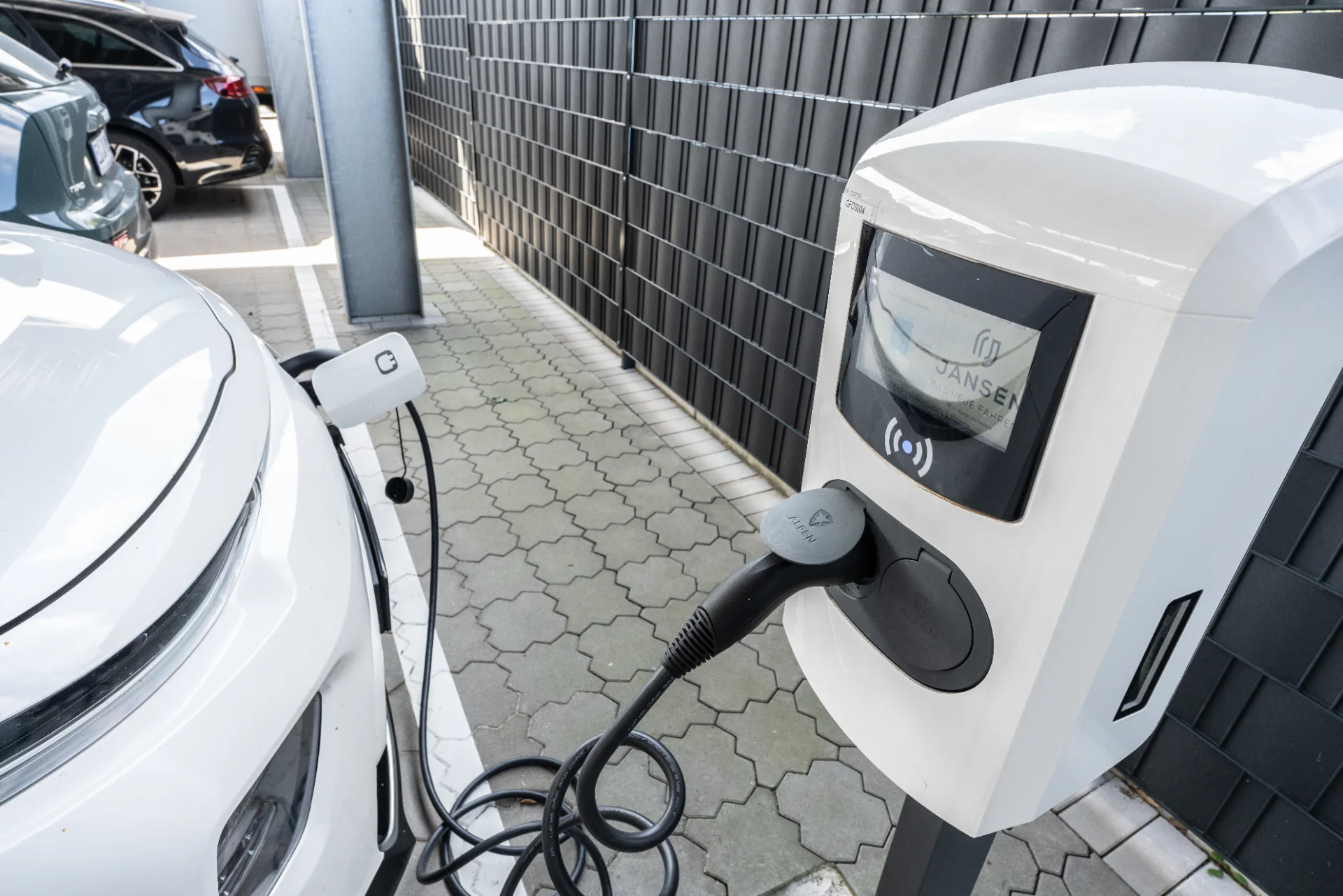
At our Lingen site, we operate our own fast-charging station — with integrated solar panels for climate-neutral energy. This means you can charge your vehicle directly with us while we service it or you take a test drive. Using the Jansen e-mobility Charge system, you can register in just a few minutes and then use the HPC columns at transparent prices.

Jansen e-mobility Charge

Register now for Jansen e-mobility

Conveniently charge your electric vehicle at our fast charging station — with transparent prices and easy billing. Register in just a few steps.

Jansen e-mobility Registrierung

Registrieren Sie sich jetzt für Jansen e-mobility Charge und laden Sie Ihr E-Auto bequem bei Autohaus Jansen.

Money for your e-car

THG premium: 260 € per year — completely effortless

Every owner of a purely electric vehicle can apply for the Greenhouse gas reduction quota (THG quota) annually and receive payment. You save CO₂ — others pay you money for it.

Through our partner geld-fuer-eauto.de, this can be done in just a few minutes: Upload your vehicle registration document, select a payment option, and receive money into your account.

Free mediation via ZusammenStromen GmbH (Hamburg). 260 € guaranteed · up to 400 € (risk variant) · only applies to pure battery-electric vehicles, hybrids excluded.

E-mobility in Emsland — your local partner

The Emsland region is one of the areas in Lower Saxony where electric mobility is gaining momentum particularly quickly. Commuters to Lingen, Meppen, and Nordhorn, families from Haselünne and Quakenbrück, craftsmen, and frequent drivers from the entire district: They all ask themselves today what their next car should look like. We at Autohaus Jansen have been accompanying this change for years — with 116 vehicles in stock, our own fast-charging station in Lingen, and a master workshop trained in high-voltage technology.

Buy an electric car in Lingen, Haselünne and surrounding areas

Whether you're looking for a new car, year-old car, or certified used car: At Autohaus Jansen, you will find a consistently well-maintained portfolio of electric cars and plug-in hybrids at our two locations in Lingen (Ems) and Haselünne. We are partners of the KIA brand and also carry the electric models from Ford and BYD. Our sales advisors take the time to listen to you and work out which drive is financially and practically suitable for your specific case — without sales pressure and with the aim of finding the right car for you, not the most expensive one.

KIA, Ford and BYD — three brands, one claim

KIA has established itself in the top group of electric mobility with models like the EV6 and EV9. The 800-volt architecture allows for extremely fast charging times, and the ranges extend from around 400 to over 600 kilometers, depending on the model. Additionally, there are 7 years of manufacturer's warranty and a mature software platform. Ford is taking its own path with the Mustang Mach-E, Explorer EV, Capri, and the fully electric E-Transit — sporty, practical, and with the unmistakable Ford character. BYD is bringing fresh momentum to the European market with the Atto 3, Dolphin, and Seal: Fully equipped vehicles at fair prices, with the self-developed Blade-Battery technology, which stands for high safety and durability. We can best determine which model suits you in a brief consultation.

Range and everyday life — is an e-car right for you?

The standard question is: Can I get everywhere with this? In most cases, the answer is: Yes, effortlessly. Modern electric cars have a range of WLTP ranges of 400 to 600 kilometres; in practice, realistic values are between 300 and 500 kilometres — depending on speed, weather and load. This is sufficient for 90 per cent of all everyday journeys. If you drive 25 kilometres to work, charge your car two to three times a week at home with a Wallbox and only need public charging points on holiday, you're all set. For the few exceptions, there are now over 100,000 public charging points in Germany — a number that's still rising sharply, especially along the A30 and A31 around the Emsland region.

Wallbox and fast charging — the right charging infrastructure

Charging Charging at home with an 11-kW Wallbox takes 6 to 8 hours overnight — and it's by far the cheapest option. For long-distance driving and customers without their own Wallbox, we're building one of the largest fast-charging stations in the region at our Lingen site: HPC columns for all common models, combined with solar panels for an increasingly large share of our own, climate-neutral electricity. Using the Jansen e-mobility Charge system, you can register in just a few minutes directly on this page and then use the columns at transparent prices — conveniently via app billing or direct payment.

Funding, THG premium and tax benefits

Even though the environmental bonus from the federal government expired at the end of 2023 and the KfW programs for e-cars and wallboxes are currently paused, there are still tangible financial benefits: Pure e-cars are exempt from vehicle tax in Germany until 2030, company cars are taxed at only 0.25 percent instead of 1 percent (monetary benefit), and every e-car owner can sell the THG quota annually through our partner geld-fuer-eauto.de — guaranteed 260 euros, up to 400 euros per year, depending on the variant. As soon as the new federal funding planned is available, we will keep you informed.

Workshop and service for electric vehicles

High-voltage vehicles require a different workshop competence than classic combustion engines. Our mechatronics engineers are HV-certified (HV level 1/2S) and work with the manufacturer-specific diagnostic technology from KIA and Ford — as well as with the approved tools for BYD and all other brands. From regular service to software updates to battery health analysis: Your electric vehicle is in good hands with us. You can schedule appointments online or by phone under +49 591 800670.

Test drive and consultation — get in touch without obligation

The most honest way to find out if an e-car is right for you is through a personal test drive. We will schedule an appointment with you at the location in Lingen or Haselünne that is most convenient for you, and take the time to answer all your questions — from charging infrastructure to range and the right financing through our partner Santander. You can schedule your personal e-mobility consultation online using our contact form or call us directly.

Frequently asked questions about e-mobility

The answers we are asked most often — brief and honest.

Is an e-car financially worthwhile?

In many cases, yes — especially with high annual mileage. Electricity costs are significantly lower than petrol/diesel costs, maintenance is cheaper (no oil changes, less wear and tear), and pure e-cars are exempt from vehicle tax in Germany until 2030. We would be happy to calculate your individual case.

How far can I travel on a single charge?

Modern electric cars have a 400–600 km WLTP range, in practice around 300–500 km depending on speed and weather. This is more than sufficient for everyday use in the Emsland — charging at home or at the workplace covers the majority of journeys.

And the battery won't last just two years, will it?

No. Modern batteries are designed to last 8–10 years or 160,000 km and more. For example, KIA offers a 7-year warranty on the battery. Degradation in current models is only around 1–2 % per year.

What if I'm unable to charge while on the move?

The charging network is growing rapidly — Germany has over 100,000 public charging points, many of them along the A30 and A31 in the Emsland region. For everyday life, charging at home or at work is sufficient. And at our Lingen site, one of the largest fast-charging stations in the region is currently being built.

Don't petrol engines have a better environmental balance?

No. Over the entire life cycle (including battery production), e-cars in Germany cause around 40-50% less CO₂ than comparable petrol engines — with a rising trend as the proportion of renewable energies in the power mix increases.

Is a plug-in hybrid a good compromise?

For many drivers, yes — especially if the commute is under 50 km and charging is done regularly. In city traffic, you drive electrically, and on long journeys, you have the petrol engine as a backup. Important: only those who charge regularly really benefit from the hybrid.

What subsidies are available in 2026 for private individuals?

The federal environmental bonus expired at the end of 2023, and the KfW programmes for e-car wallboxes are currently on hold. However, there are still tax advantages: vehicle tax exemption until 2030, 0.25% taxation as a company car, and the annual THG premium for pure e-cars. As soon as a new federal subsidy is available, we will inform you.

How to reach us

Just pick whichever way suits you best.